Showing posts with label culture. Show all posts
Friday, May 4, 2012
Australia's national apology
I see graffiti like this littered around Sydney - the word "sorry" painted on street curbs, on the sides of buildings, on bridges & the backs of road signs. I don't know much about this issue - I'm only a visitor here in Australia - but my Australian friends say that the messsage is directed at the aboriginals who were part of the stolen generation.
If you've ever seen the movie Rabbit Proof Fence, you saw aboriginal children forcefully taken from their parents by the government & placed in reform schools, where they were taught European customs & traditions. The Australian governement hoped that these children would then assimilate into white society, & that the aboriginal culture would ultimately be eradicated. It took the Australian government until 2008 - just four years ago - to apologize.
Today, people continue to say "sorry" in their own way.
Tuesday, April 26, 2011
Chinese Fables: Kong Rong Giving Up Pears
In the park near my apartment complex, there are several statue vignettes depicting well-known Chinese fables. This one shows Kong Rong, the Han Dynasty scholar, politician & warlord, who is famous for his act of filial piety as a young boy.
According to the plaque next to this sculpture, when Kong Rong was four years old, he was given the opportunity to choose a pear from several. Instead of taking the largest pear, he took the smallest pear, saying that the larger pears should be eaten by his older brothers.
The story is used today to teach children to respect their elders. While searching for more information on the story, I came across this blog post written by a woman who discussed Kong Rong with her five-year-old son who was learning about him in school.
At first, he didn't understand why he needed to give the larger pear to his older brother, but finally conceded that since Kong Rong did it, he should do it too. But when his mother tried to apply the principle to chocolate cookies, the five-year-old refused to see the connection. Kong Rong gave his brothers pears, not chocolate cookies!
| 13 March 2011 |
| 23 April 2011 |
According to the plaque next to this sculpture, when Kong Rong was four years old, he was given the opportunity to choose a pear from several. Instead of taking the largest pear, he took the smallest pear, saying that the larger pears should be eaten by his older brothers.
The story is used today to teach children to respect their elders. While searching for more information on the story, I came across this blog post written by a woman who discussed Kong Rong with her five-year-old son who was learning about him in school.
At first, he didn't understand why he needed to give the larger pear to his older brother, but finally conceded that since Kong Rong did it, he should do it too. But when his mother tried to apply the principle to chocolate cookies, the five-year-old refused to see the connection. Kong Rong gave his brothers pears, not chocolate cookies!
Sunday, April 3, 2011
Tomb Sweeping Day
Last year, I got all excited about Tomb Sweeping Day, a holiday that is similar in essence to the Latin American Day of the Dead. I wanted to visit a cemetery to see people sprucing up the tombs in anticipation of a visit from their ancestors, to smell the incense & paper money burning, to hear the quiet prayers of the devoted.
But my students looked at me like I was nuts. I soon realized that, at least in Shanghai, the most popular way to spend a holiday - any holiday - is shopping at the mall. To heck with all that traditional old-school stuff. China is modern! Shopping & movies & karaoke!
So this year I've got another plan. Since it's a four-day weekend, I'm going to spend the holiday at a monastery a couple of hours from Shanghai. I'm looking forward to relaxing in a peaceful place, away from the bustle & hustle of the city, eating lots of good vegetarian food, & watching butterflies flutter by. It'll be nice to see nature again, & I may even see a tomb or two swept.
But my students looked at me like I was nuts. I soon realized that, at least in Shanghai, the most popular way to spend a holiday - any holiday - is shopping at the mall. To heck with all that traditional old-school stuff. China is modern! Shopping & movies & karaoke!
So this year I've got another plan. Since it's a four-day weekend, I'm going to spend the holiday at a monastery a couple of hours from Shanghai. I'm looking forward to relaxing in a peaceful place, away from the bustle & hustle of the city, eating lots of good vegetarian food, & watching butterflies flutter by. It'll be nice to see nature again, & I may even see a tomb or two swept.
Saturday, March 19, 2011
What's That You Say?
When I was living in Arizona, one of the most frequent comments that people would make when they found out that I speak Spanish was "It must be nice to be able to understand what they're saying about you".
However, in all my comings & goings around Spanish speakers, I never once heard anyone I didn't know talk about me in Spanish as I waited in the line at the grocery store - or anywhere else for that matter.
Of course, I did my fair share of eavesdropping, but the conversations that I heard were almost always about mundane things - "Did you get the avocados?", "How much were the tortillas?", "Papa called & said to hurry up with the piñata." They were in their own worlds, talking about what was important to them - I didn't figure into their chit-chat.
I've been in China for a little over a year now, & I've been earnestly trying to add Chinese to my foreign-language repertoire. My current language studies include eavesdropping on other people's conversations to see how much I can understand. I spend my days surrounded by a cacophany of unintelligible language, but each day I understand just a little bit more.
The other day I noticed that I can now get the gist of what people are saying - for the most part. Even though I don't understand the details, I can tell if someone is talking about their plans for the weekend or what they had for lunch. & surprisingly, I've started to hear other people talking about me.
I often notice people noticing me. I'm a foreigner here & people are amazed by that. When I step on the subway, people often do a double-take then quickly look away, trying not to stare. Some people take photos of me with their cell phones, trying to make it look like they're checking their email. Children point at me & tell their parents they see a laowai, a foreigner.
All of this I've been experiencing from the start. But now that my Chinese is kind of decent, I'm also starting to hear people say things like, "Hey Zhou, look at the foreigner!" or "That foreigner sure is tall" or "I bet she's from England." Often I pretend that I don't understand, allowing myself to be the object of speculation, the mysterious white alien. It's kind of fun. My next language learning challenge will be to actually respond to their comments - in a nice way, of course.
Learning another language opens lots of doors for us. We can learn about another culture, speak to people from other countries, & get a much better understanding of the world around us. It also takes away the mystery & makes what was once alien & exotic seem terrestrial. Our fantasy version of a culture is tranformed into reality - a reality where we're not so different from each other after all.
However, in all my comings & goings around Spanish speakers, I never once heard anyone I didn't know talk about me in Spanish as I waited in the line at the grocery store - or anywhere else for that matter.
Of course, I did my fair share of eavesdropping, but the conversations that I heard were almost always about mundane things - "Did you get the avocados?", "How much were the tortillas?", "Papa called & said to hurry up with the piñata." They were in their own worlds, talking about what was important to them - I didn't figure into their chit-chat.
I've been in China for a little over a year now, & I've been earnestly trying to add Chinese to my foreign-language repertoire. My current language studies include eavesdropping on other people's conversations to see how much I can understand. I spend my days surrounded by a cacophany of unintelligible language, but each day I understand just a little bit more.
The other day I noticed that I can now get the gist of what people are saying - for the most part. Even though I don't understand the details, I can tell if someone is talking about their plans for the weekend or what they had for lunch. & surprisingly, I've started to hear other people talking about me.
I often notice people noticing me. I'm a foreigner here & people are amazed by that. When I step on the subway, people often do a double-take then quickly look away, trying not to stare. Some people take photos of me with their cell phones, trying to make it look like they're checking their email. Children point at me & tell their parents they see a laowai, a foreigner.
All of this I've been experiencing from the start. But now that my Chinese is kind of decent, I'm also starting to hear people say things like, "Hey Zhou, look at the foreigner!" or "That foreigner sure is tall" or "I bet she's from England." Often I pretend that I don't understand, allowing myself to be the object of speculation, the mysterious white alien. It's kind of fun. My next language learning challenge will be to actually respond to their comments - in a nice way, of course.
Learning another language opens lots of doors for us. We can learn about another culture, speak to people from other countries, & get a much better understanding of the world around us. It also takes away the mystery & makes what was once alien & exotic seem terrestrial. Our fantasy version of a culture is tranformed into reality - a reality where we're not so different from each other after all.
Thursday, March 17, 2011
Barbie Shanghai Closes
Well that didn't last long, did it?
I guess Barbie doesn't appeal much to the Chinese market, where Hello Kitty reigns & women wear contact lenses that make them look like a deer in headlights. Cute & round is much more popular here than tall & sexy.
Perhaps a whole store dedicated to Skipper would have been more successful.
Thursday, February 3, 2011
Happy Chinese New Year!
Chinese New Year is also called Spring Festival in China - it's a time for new beginnings & looking to the future. People put on new clothes, especially if they're red. There's red underwear in all the stores, along with lots of other red new years gear. I even got myself a pair of red socks for the occasion.
People start the year by hanging bright red banners with good luck sayings on the doors to their homes, & give each other red & gold envelopes with money inside, thereby increasing their favor with the gods - the gods they don't believe in any more.
Chinese culture bases a lot of its traditions on word play. For example, at the new year, people eat fish because the word for fish (鱼 yú) sounds like the word for abundance (余 yú).
One of my favorite plays on words is the one pictured here. The character for good fortune is 福, pronounced "fú". Often people hang this character upside down during Spring Festival. The word for upside down is 倒了 dào le, which sounds like the word for arrived: 到了 dào le. So if you hang the good fortune character upside down, then it's "fu dào le" - "fu" is upside down, or good fortune has arrived - a great sentiment for the new year.
Happy New Year to you all! 新年快乐!
Monday, January 24, 2011
Random Thoughts by China Man
I went to a language exchange meeting over the weekend, where we spent several hours helping each other practice English or Chinese. It was fun & I met a lot of interesting people.
One man was particularly interesting. I guess he was around 65 years old. He'd had a lot of diverse life experiences & was happy to share them with us. He'd been in the army, suffered the Cultural Revolution, seen Shanghai turn into a bustling metropolis, & much more.
He said he had learned to speak five or six foreign languages so that he could have access to books & newspapers that hadn't yet been translated into Chinese. His life philosophy seemed to boil down to this: Knowledge is power.
As I listened to him, he just kept spouting off one great quote after another. I was able to write some of them down, but many more escaped me. Here are just a few.
"Foreign languages are like windows. I live in a black house & I want more light."
"In America, they have a weak government but a strong society. But in China, we have a strong government and a weak society."
"Modern China is made by Japan."
One man was particularly interesting. I guess he was around 65 years old. He'd had a lot of diverse life experiences & was happy to share them with us. He'd been in the army, suffered the Cultural Revolution, seen Shanghai turn into a bustling metropolis, & much more.
He said he had learned to speak five or six foreign languages so that he could have access to books & newspapers that hadn't yet been translated into Chinese. His life philosophy seemed to boil down to this: Knowledge is power.
As I listened to him, he just kept spouting off one great quote after another. I was able to write some of them down, but many more escaped me. Here are just a few.
"Foreign languages are like windows. I live in a black house & I want more light."
"In America, they have a weak government but a strong society. But in China, we have a strong government and a weak society."
"Modern China is made by Japan."
Wednesday, December 15, 2010
Old vs. New
When you stand on the river walk on the bank of the Huang Pu River in Shanghai, you have a great view of both sides of the waterway. On the west side, you see an impressive row of European style architecture built in the early 1900s. On the east side of the river, you see a crowd of stunning skyscrapers, which have all been built within the last 20 years. The contrast is stark - a visual representation of Shanghai's past & future.
When my parents were here in September, our tour guide Lynn took us to the river side to take photos & gawk at the other tourists. While we were there, Lynn commented that when she takes foreigners to see the river, they almost always turn to look at the old buildings & marvel at the intricate art deco designs. When she takes Chinese tourists to see the same river, they invariably look towards the modern high rises, impressed by how they gleam.
Indeed, Lynn's observation could be broadened to apply to cultural attitudes in general. In the West, everyone loves old things. People are always buying antiques, restoring old buildings, & getting in touch with their roots.
Whereas in the East, the past couldn't be sloughed off quick enough. If it's more than 20 years old, no one wants it. Countless old buildings are demolished every day in favor of 20-storey apartment buildings. Traditional music & clothing is scoffed at as out-dated & useless. The old ways are being replaced by the latest in design, technology & comfort, & no one is looking back - China has torn off its rearview mirror & tossed it out the window.
Some might say it's unfortunate that Ming Dynasty pagodas are being replaced with McDonalds & Starbucks on every corner. However, those that would lament have the luxury to do so. The West has already developed industry & commerce to such an extent that people can comfortably sit back, take a deep breath & sigh about days gone by.
China, on the other hand, is on the verge of something huge - they're charging into the future at a break-neck pace, & they don't have time for the extravegance of looking to the past. Right now, the past is just in the way of progress.
![]() |
| Puxi - West Bank |
![]() |
| Pudong - East Bank |
Indeed, Lynn's observation could be broadened to apply to cultural attitudes in general. In the West, everyone loves old things. People are always buying antiques, restoring old buildings, & getting in touch with their roots.
Whereas in the East, the past couldn't be sloughed off quick enough. If it's more than 20 years old, no one wants it. Countless old buildings are demolished every day in favor of 20-storey apartment buildings. Traditional music & clothing is scoffed at as out-dated & useless. The old ways are being replaced by the latest in design, technology & comfort, & no one is looking back - China has torn off its rearview mirror & tossed it out the window.
Some might say it's unfortunate that Ming Dynasty pagodas are being replaced with McDonalds & Starbucks on every corner. However, those that would lament have the luxury to do so. The West has already developed industry & commerce to such an extent that people can comfortably sit back, take a deep breath & sigh about days gone by.
China, on the other hand, is on the verge of something huge - they're charging into the future at a break-neck pace, & they don't have time for the extravegance of looking to the past. Right now, the past is just in the way of progress.
Sunday, December 12, 2010
Even the Water Is Fake
When I was staying at the Happy Dragon Hostel in Beijing, I noticed that there were some incredibly loud frogs croaking through the night. Then I noticed that the loud croaking didn't seem to move around at all, & that the frogs kept making the same sound patterns. As with just about everything else in China, the frogs were fake.
Some of the fake goods available here are actually great buys. Although they blatantly violate copywrite laws, pirated DVDs and copy books are cheap & widely available. I can get a DVD for about a dollar, & copy books cost $2-$3 each. The quality isn't as good as the real thing, but that doesn't make much difference to someone like me. I'm not going to keep them after I'm finished watching or reading them anyway.
Of course knock-off brands are everywhere - clothing, computers, cosmetics. Most of the real stuff is made in China anyway, so it's not that difficult to copy it & then sell it at the fake market right down the street from the posh boutiques. In China, even the beggars wear Gucci.
In class the other day, we were discussing competition & cooperation in the workplace. One of the students was talking about his job as a bottled water salesman. He said that of course there is a lot of competition in his job - he strives to sell more water than the other sales people. But he said he also depends on cooperation among the sales people, who need to band together against fake water.
Fake water? How can water be fake? He said that about 30% of the bottled water available in Shanghai is bottled by small companies who print labels to look like the brand names. Most of the time these bottles contain nothing but tap water. But he said that most likely the water we buy in supermarkets & quickie marts it legit. We just need to be careful of the bottled water sold on the street, or outside tourist attractions.
That's good advice when buying anything on the street, be it bottled water or a new watch. Buyer beware: If it's cheap, there's probably a reason for it.
Monday, December 6, 2010
Caught in a Bubble
I teach English here in Shanghai. One of my classes is a Travel Club where we study a different country each week. This week we did New Zealand. I found a photo of a popular sport there called Zorbing. It looks like loads of fun! Apparently you can do this in Shanghai, but I'm still trying to find out where.
Anyhow, since it is such as unsual object, I decided to use it as a creativity exercise. The students were to imagine that this huge plastic ball was something else. To get them started, I gave them some ideas. I said that it could be a new mode of transportation that will eventually replace cars. Or it could be an alien spacecraft that has landed on earth. Or it could be a man caught in a soap bubble.
They laughed at the thought of driving one of these around the streets of Shanghai, & they enthusiastically began adding to the story about the aliens, but that last one simply confused them. They couldn't understand how someone could get caught in a soap bubble. It's just not possible in their minds. Bubble cars? Possible. Soap bubble traps? Not possible.
It made me think about how our cultural backgrounds play such a huge role in how we perceive our environment. I grew up with cartoons like the one here, in which one of the characters gets a little too close to the soap, & winds up flying through the air in a soap bubble. When they get too high the bubble always pops & they plummet to earth.
But here in China, I guess they've never seen cartoons like this. They've never been exposed to the idea of flying through the air in a soap bubble. So for them, it's just not possible.
So I left them to come up with more appropriate uses for the Zorbing ball. One group said it was a new medical treatment for heart disease - the rolling around helps with circulation. Another group decided it was protection against falling debris during an earthquake. A third group said that it was a vehicle to travel under the sea. All wonderfully creative ideas. Still, the soap bubble idea never caught on, & it leaves me to wonder what kinds of things I think are not possible because of my own cultural background.
What about you? What do you think is impossible?
Saturday, December 4, 2010
Waffles
I walk down a side street looking for some street food for lunch. I find a section lined with food stalls - people selling everything from fried noodles to fruit on a stick to stinky tofu. I notice one stall selling crunchy waffles rolled up tight & cut into pieces big enough to eat with your hands.
A man is sitting in front of a make-shift grill - a metal box filled with burning hot coals. He's working three waffle irons. They look heavy. He has a rhythm going. He dips a ladel into a large bucket at his feet & pours some waffle batter into the first iron. He moves the iron down one spot, flips the second iron over & shifts it down too. He takes the third iron off the fire, opens it & removes the piping hot waffle with his bare hands. He tosses it onto the table next to him, moves the third iron back to the first position & ladels more waffle batter on. Repeat.
Meanwhile, a woman is sitting at the table. She takes the finished waffle & rolls it up before it can cool. She puts it into a cutter & lowers the lever - three hand-sized waffle rolls come out & she tosses them into a bin. Customers reach into the bin & select their waffles. They throw coins into a tin resting on the table. The woman has no time to count out change - fresh waffles keep coming down the production line.
I stand & watch the process for about five minutes, then walk on down the street to a noodle vendor. I sit & eat my noodles surrounded by chattering people on their lunch break. A half hour later, I return the way I came. The waffle man is still moving waffle irons back & forth. The woman is still rolling & cutting, trying to keep up with demand.
A man is sitting in front of a make-shift grill - a metal box filled with burning hot coals. He's working three waffle irons. They look heavy. He has a rhythm going. He dips a ladel into a large bucket at his feet & pours some waffle batter into the first iron. He moves the iron down one spot, flips the second iron over & shifts it down too. He takes the third iron off the fire, opens it & removes the piping hot waffle with his bare hands. He tosses it onto the table next to him, moves the third iron back to the first position & ladels more waffle batter on. Repeat.
Meanwhile, a woman is sitting at the table. She takes the finished waffle & rolls it up before it can cool. She puts it into a cutter & lowers the lever - three hand-sized waffle rolls come out & she tosses them into a bin. Customers reach into the bin & select their waffles. They throw coins into a tin resting on the table. The woman has no time to count out change - fresh waffles keep coming down the production line.
I stand & watch the process for about five minutes, then walk on down the street to a noodle vendor. I sit & eat my noodles surrounded by chattering people on their lunch break. A half hour later, I return the way I came. The waffle man is still moving waffle irons back & forth. The woman is still rolling & cutting, trying to keep up with demand.
Wednesday, December 1, 2010
The Fish Market
There is a small fish market down the street from my apartment. I pass by there occasionally on my way to the bank. It seems that every time I walk by I see something that shocks me.
One time I saw the woman who works there scaling fish that were still alive, their blood splattering the metal pan she was holding them over. Another time, a fish had jumped out of his tank in an attempt at escape. It landed on the floor near a customer's shoe. The man looked down & nonchalantly kicked it under the counter, as if it were a carrot that had dropped on the floor. Today I was walking by the same fish market when I saw something flip out of the corner of my eye. I looked over & saw a fish writhing in a bucket filled with several other live fish whose tails & fins had all been cut off. Instead of water, they were swimming in blood.
In class one day, a student said that he didn't eat tuna because killing dolphins is cruel. I asked him why & he said that dolphins are intelligent. Did he mean that we shouldn't kill dolphins because they might be able to shed light on the origin of the universe? No. He said that the more intelligent the animal, the more pain they feel, so a dolphin would suffer a lot more than, say, a fish in the market. The other students around him agreed.
One time I saw the woman who works there scaling fish that were still alive, their blood splattering the metal pan she was holding them over. Another time, a fish had jumped out of his tank in an attempt at escape. It landed on the floor near a customer's shoe. The man looked down & nonchalantly kicked it under the counter, as if it were a carrot that had dropped on the floor. Today I was walking by the same fish market when I saw something flip out of the corner of my eye. I looked over & saw a fish writhing in a bucket filled with several other live fish whose tails & fins had all been cut off. Instead of water, they were swimming in blood.
In class one day, a student said that he didn't eat tuna because killing dolphins is cruel. I asked him why & he said that dolphins are intelligent. Did he mean that we shouldn't kill dolphins because they might be able to shed light on the origin of the universe? No. He said that the more intelligent the animal, the more pain they feel, so a dolphin would suffer a lot more than, say, a fish in the market. The other students around him agreed.
Wednesday, November 17, 2010
Expat Explorer Survey
The 2010 HSBC Expat Explorer Survey was recently published. It compiles answers from over 4000 expats living in 25 countries about their lifestyles, including topics like finances, social ties and family life. It’s an interesting – albeit simplified – view of life as a foreigner in various countries.
One thing that caught my attention was that the biggest concern for all expats was being able to establish a social life in the new country, & that women more than men worried about making local friends.
Here’s the summary from the report:
Moving abroad can understandably be daunting for any potential expats and this year’s report reveals that emotive worries cause much greater concern than practical issues. The most common concern for expats ahead of moving to their new country is re-establishing a social life (41%), feeling lonely and missing friends and family (34%).
The same worries are also much more prominent for female expats. Nearly half of female expats surveyed (48%) shared concerns about re-establishing their social life in their new country, compared to only 37% of men and 44% of female expats shared concerns about missing their friends and family, compared to less than one third (29%) of men.
This was definitely one of my main concerns when I was getting ready to leave the US. I was worried about leaving my friends behind, knowing I would miss them terribly. I made sure I saw everyone at least one last time before I boarded the plane to Vietnam. I hugged them tight, tears slipping down my cheeks as I finally said goodbye.
Once in Vietnam, I found that it was difficult to make local friends. Try as I might, my American friend-making approach just didn’t work there. Vietnam is not included on HSBC’s survey, but if it were, it would probably be near the bottom of the list for “Local Integration”.
China as it turns out ranks 17th out of 25 countries for ease of integration with the local population, which is also rather low. In the ten months that I have lived in Shanghai, I have made one or two local friends, but our relationship is not close. Again, I’ve tried everything I know to meet locals & form friendships, but I haven’t quite cracked the friendship code here yet.
One thing I have discovered, though, is that people see friends & friendships differently here in China than we do in the US. Back home, my friends are people that I like, people that I want to hang out with, go to a movie with or have a drink with after work. They’re people I respect & admire, who are my role models & my inspiration.
In China, on the other hand, friends are seen as people who can help you, people who can introduce you to business associates or boyfriends. They’re not necessarily people that you like, but they have been your friend since you were a child. The ties are strong, enduring & often unbreakable.
So it’s difficult to make local friends in China because friendship is just different here. Chinese people don’t seek out new friends once they become adults – they have enough of them already – which means the foreigners who come here tend to spend a lot of time with other foreigners.
Tuesday, November 16, 2010
Bored Laowai
I’ve been reading Rachel DeWoskin’s Foreign Babes in Beijing, about her experiences working on the set of a Chinese soap opera. She tells her story with wit & charm, & I find myself smiling & nodding as I read because her story is more about life as a foreigner in China than about being a soap star, & I can relate to a lot of what she says.
I was sitting at Starbucks on my day off, quietly chuckling to myself as I read her take on conversations with other foreigners:
Expatriate small talk ran a predictable gamut. There was “How long have you been in Beijing?” usually accompanied by the subtext “I’ve been here longer.” Or the more direct “How is your Chinese?” which carried with it the thinly veiled “Mine is better.” Finally, I dreaded most the “What are you doing in China?” and my embarrassed response that I was working in public relations.
I’ve had this same conversation with countless foreigners. Of course I substitute “teaching English” for “working in public relations”, but I feel the same condescension from other expats as DeWoskin did.
It seems that if you’re teaching English in China, you’re considered an inexperienced newbie, fresh off the fabled boat. You haven’t yet found something more worthwhile to do – like starting an import-export company or opening a bar where you can hire karaoke bands & flirt with the locals.
As I sat at Starbucks sipping my coffee, Christmas music wafting through the sound system, a gingerbread cookie warm in my belly, a good-looking guy, 50-something, sat at the table next to mine & pulled out his MacBook.
After a few surreptitious glances in my direction, he leaned over & asked me what I was reading. I showed him the book cover & he said, “Oh… Isn’t that a bored laowai (foreigner) book?” What do you mean?, I asked. “Isn’t that just like every other book about China – you know, with stories about taxi drivers & street food?” I thought of my blog & quickly looked away.
The cloud I had been soaring on because I had found a book that understood me slowly drifted back to earth & deposited me there. How embarrassing to be called out as the newbie that I am. I pretended to continue reading, but couldn’t stop thinking of what he had said.
I’ve been in China for less than a year – a newbie indeed. But for me, most of the joy of living life abroad is the newness of it – discovering things that are different from home, & gaining a new perspective on my own life while I’m at it.
Perhaps what’s really regrettable is getting over that feeling of excitement & wonder – to lose that feeling of inexperience in a foreign country. My friend at the coffee shop may be a “bored laowai” who knows more about living in China than I do, but at least I can still appreciate the taxi drivers & street food. I think life in China is fascinating, & I’m not ashamed to admit it.
I was sitting at Starbucks on my day off, quietly chuckling to myself as I read her take on conversations with other foreigners:
Expatriate small talk ran a predictable gamut. There was “How long have you been in Beijing?” usually accompanied by the subtext “I’ve been here longer.” Or the more direct “How is your Chinese?” which carried with it the thinly veiled “Mine is better.” Finally, I dreaded most the “What are you doing in China?” and my embarrassed response that I was working in public relations.
I’ve had this same conversation with countless foreigners. Of course I substitute “teaching English” for “working in public relations”, but I feel the same condescension from other expats as DeWoskin did.
It seems that if you’re teaching English in China, you’re considered an inexperienced newbie, fresh off the fabled boat. You haven’t yet found something more worthwhile to do – like starting an import-export company or opening a bar where you can hire karaoke bands & flirt with the locals.
As I sat at Starbucks sipping my coffee, Christmas music wafting through the sound system, a gingerbread cookie warm in my belly, a good-looking guy, 50-something, sat at the table next to mine & pulled out his MacBook.
After a few surreptitious glances in my direction, he leaned over & asked me what I was reading. I showed him the book cover & he said, “Oh… Isn’t that a bored laowai (foreigner) book?” What do you mean?, I asked. “Isn’t that just like every other book about China – you know, with stories about taxi drivers & street food?” I thought of my blog & quickly looked away.
The cloud I had been soaring on because I had found a book that understood me slowly drifted back to earth & deposited me there. How embarrassing to be called out as the newbie that I am. I pretended to continue reading, but couldn’t stop thinking of what he had said.
I’ve been in China for less than a year – a newbie indeed. But for me, most of the joy of living life abroad is the newness of it – discovering things that are different from home, & gaining a new perspective on my own life while I’m at it.
Perhaps what’s really regrettable is getting over that feeling of excitement & wonder – to lose that feeling of inexperience in a foreign country. My friend at the coffee shop may be a “bored laowai” who knows more about living in China than I do, but at least I can still appreciate the taxi drivers & street food. I think life in China is fascinating, & I’m not ashamed to admit it.
Sunday, November 14, 2010
Face
But really, there is nothing distinctly Asian about “face”. We all want to protect the image that we show to the public, no matter what country we’re from. No one likes to look stupid or feel embarrassed in front of others – that’s a universal sentiment. We all want people to think we’re nice or generous or badass, & none of us wants that public image to be tarnished.
Everyone has a persona that we show to others, our various masks – or faces – that we put on & take off depending on who we’re with. At work I put on my “teacher” face – I’m responsible, organized, & knowledgeable. When I’m out with friends, I put on my “friend” face – I tell jokes & laugh easily, & I try to be accommodating. When I’m with strangers, I even have a “stranger” face – I’m kind & considerate without being invasive. These are the “faces” that everyone has & that everyone tries to protect.
If you trip & fall in public, how do you feel? That’s the feeling of losing face. If you make a big mistake at work & get fired, you feel embarrassed, ashamed, & rejected. That’s what it feels like to lose a lot of face. It’s the same the world over. In Asia they call it “losing face”, in the West, we call it “feeling stupid”.
Just like in the West, losing face – or looking stupid – in Asia is not such a big deal. You might make mistakes, as everyone does, but you & everybody else soon get over it & move on with your lives.
So why do we use this word "face" when we talk about being embarrassed in Asia? Probably because there's no one word in English that describes it as concisely - the English language is known for borrowing words when it doesn't have its own that are suitable. But no matter what you call it, we all have it & we can all lose it occasionally.
Thursday, November 11, 2010
Dear Monkey!
I just finished reading the famous tale of the Monkey King. What a great story!
I first heard of this mischievous creature when I lived in Vietnam, where the story was played over & over again on Vietnamese TV. At the time, I didn't know what it was all about, but after I moved to China, I found out that it's a well-known Chinese tale. Everyone in the East knows who the Monkey King is, just as everyone in the West knows who Cinderella is. So I decided that since I'm living in China, I should try reading it.
However, the story was written in the 16th century, & is more than 1000 pages long in PDF form (!), so I was hesitant to get started on it. Luckily, one of the other teachers at my school came to work one day with a copy of the story in a 350-page novel. Now that I could handle.
The book is a 1942 abridged translation of the story by Arthur Waley, the most widely available version of the tale in English, & was a surprisingly quick read. The story is full of the adventures & misadventures of the Monkey King & his companions as they travel 108 leagues (a lucky number) from China to India to retrieve the holy scriptures of Buddhism. In the end, the Monkey King reaches enlightenment as a result of his efforts.
The story is entertaining, with lots of action (fighting off dragons & the like), along with some crazy magic (Monkey can pull out one of his hairs & turn it into anything he wants), as well as a little bit of humor (they hide some Taoist idols in the outhouse). But my favorite part, at least of this version of the story, is that Waley says "Dear Monkey!" every time Monkey is about to do something amazing. Ha!
Have you ever read this story before? What did you think of it?
I first heard of this mischievous creature when I lived in Vietnam, where the story was played over & over again on Vietnamese TV. At the time, I didn't know what it was all about, but after I moved to China, I found out that it's a well-known Chinese tale. Everyone in the East knows who the Monkey King is, just as everyone in the West knows who Cinderella is. So I decided that since I'm living in China, I should try reading it.
However, the story was written in the 16th century, & is more than 1000 pages long in PDF form (!), so I was hesitant to get started on it. Luckily, one of the other teachers at my school came to work one day with a copy of the story in a 350-page novel. Now that I could handle.
The book is a 1942 abridged translation of the story by Arthur Waley, the most widely available version of the tale in English, & was a surprisingly quick read. The story is full of the adventures & misadventures of the Monkey King & his companions as they travel 108 leagues (a lucky number) from China to India to retrieve the holy scriptures of Buddhism. In the end, the Monkey King reaches enlightenment as a result of his efforts.
The story is entertaining, with lots of action (fighting off dragons & the like), along with some crazy magic (Monkey can pull out one of his hairs & turn it into anything he wants), as well as a little bit of humor (they hide some Taoist idols in the outhouse). But my favorite part, at least of this version of the story, is that Waley says "Dear Monkey!" every time Monkey is about to do something amazing. Ha!
Have you ever read this story before? What did you think of it?
Sunday, October 31, 2010
10 Things About China
1. Squatty potties
2. Spitting
3. Masses of people in the subway - fighting to get off
4. Available bike lanes everywhere in Beijing
5. Dog walking in pajamas
6. Feeling like a star chased by paparazzi - everyone taking our picture
7. Bargaining - it's normal to pay 25% of the asked price
8. Consistently fantastic architecture, even in a normal residential neighborhood
9. Government blocking of Facebook and Twitter
10.Delicious street food (excluding the fried scorpions & crickets on a stick)
Friday, October 15, 2010
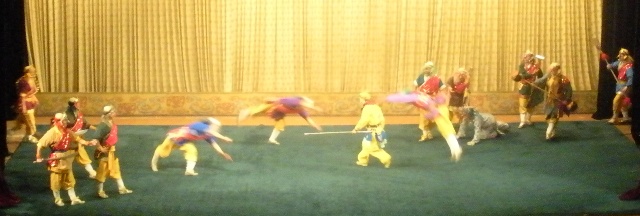
Beijing Opera
In Beijing, the Happy Dragon Hostel offered to take us to a Beijing opera for 130 RMB (about US $20). I was excited to finally see a theater production of traditional Chinese opera, which I had heard so much about.
We saw two stories. The first was about a woman who hires a boatman to take her to see her lover. It was a cute story, but the singing was a little unnerving. The female lead's shrill voice pierced the air so sharply that it hurt. I'm pretty sure they train for years to be able to do that.
The second story was about the famous Monkey King, & had less singing & more action since this particular selection was from the part of the story when the Monkey King fights off a whole band of warriors. Thank goodness.
The theater audience that night included mostly Western tourists. I wonder if Chinese people ever go to see Beijing opera, or if it's just something the tourists do.
Wednesday, September 22, 2010
Mid-Autumn Festival
Today is Mid-Autumn Festival, the day of the harvest moon, the biggest brightest moon of the year. On this day in China, families get together to sip tea, eat mooncakes & look at the moon, possibly playing a bit of mahjong & lighting a lantern or two.
When I was a little girl looking at the moon, I remember thinking how strange it was that everyone kept saying there was a man in the moon. When I looked at the moon, I saw a woman with a flowing gown dancing across the surface. (Take a look for yourself. Can you see her?) It wasn't until I was maybe five or six years old that I could finally see that the "man in the moon" was a big round face looking down at us.
It turns out that there are millions of people in Asia who saw the same thing I did, & who now tell the story during Mid-Autumn Festival of the woman who lives on the moon. As always, there are several versions of the story. You can read a couple of them here & here.
In a nutshell, a man who wanted to be immortal got hold of a make-you-immortal potion, but his wife through a series of events (depends on the version you're reading) swallowed it instead. The man was angry & tried to grab her, but she was already a goddess, so she flew into the air. Somehow (again, it depends on the version) she landed on the moon, where she spends her days with a rabbit who grinds herbs for medicine (that's another story).
The most important thing on this day in modern China is to spend the day with your family. Although they weren't thinking of the moon festival when they made their plans, my parents are arriving in Shanghai today, so I can celebrate the day in true Chinese fashion. I have a couple of mooncakes to share & we'll probably take a gander at the moon later tonight. Maybe we'll even be able to see the woman dancing across the surface.
When I was a little girl looking at the moon, I remember thinking how strange it was that everyone kept saying there was a man in the moon. When I looked at the moon, I saw a woman with a flowing gown dancing across the surface. (Take a look for yourself. Can you see her?) It wasn't until I was maybe five or six years old that I could finally see that the "man in the moon" was a big round face looking down at us.
It turns out that there are millions of people in Asia who saw the same thing I did, & who now tell the story during Mid-Autumn Festival of the woman who lives on the moon. As always, there are several versions of the story. You can read a couple of them here & here.
In a nutshell, a man who wanted to be immortal got hold of a make-you-immortal potion, but his wife through a series of events (depends on the version you're reading) swallowed it instead. The man was angry & tried to grab her, but she was already a goddess, so she flew into the air. Somehow (again, it depends on the version) she landed on the moon, where she spends her days with a rabbit who grinds herbs for medicine (that's another story).
The most important thing on this day in modern China is to spend the day with your family. Although they weren't thinking of the moon festival when they made their plans, my parents are arriving in Shanghai today, so I can celebrate the day in true Chinese fashion. I have a couple of mooncakes to share & we'll probably take a gander at the moon later tonight. Maybe we'll even be able to see the woman dancing across the surface.
Monday, September 20, 2010
Street Dancing
On a normal day in Shanghai, it's not uncommon for me to come across groups of people dancing. They gather in parks in the evenings or in front of shopping malls on the weekends to dance the waltz, the cha-cha, even the tango. I'm amazed at how many Chinese people can dance a decent mambo.
Usually there is a boom box or stereo set up outside, which plays a variety of music suitable for ballroom dancing, & anyone can join in - it's free to dance.
So far, I've just been a spectator at these events. I haven't figured out if you need to bring your own partner or if you just wait on the sidelines until someone asks you to dance, but I think it would be fun to participate in a public dance session like this. I don't know many moves, but it's just for fun anyway.
Usually there is a boom box or stereo set up outside, which plays a variety of music suitable for ballroom dancing, & anyone can join in - it's free to dance.
So far, I've just been a spectator at these events. I haven't figured out if you need to bring your own partner or if you just wait on the sidelines until someone asks you to dance, but I think it would be fun to participate in a public dance session like this. I don't know many moves, but it's just for fun anyway.
Subscribe to:
Posts (Atom)