Buy my photos!

Notecards for $2.40

Thursday, October 13, 2011

Tibetan prayer flags

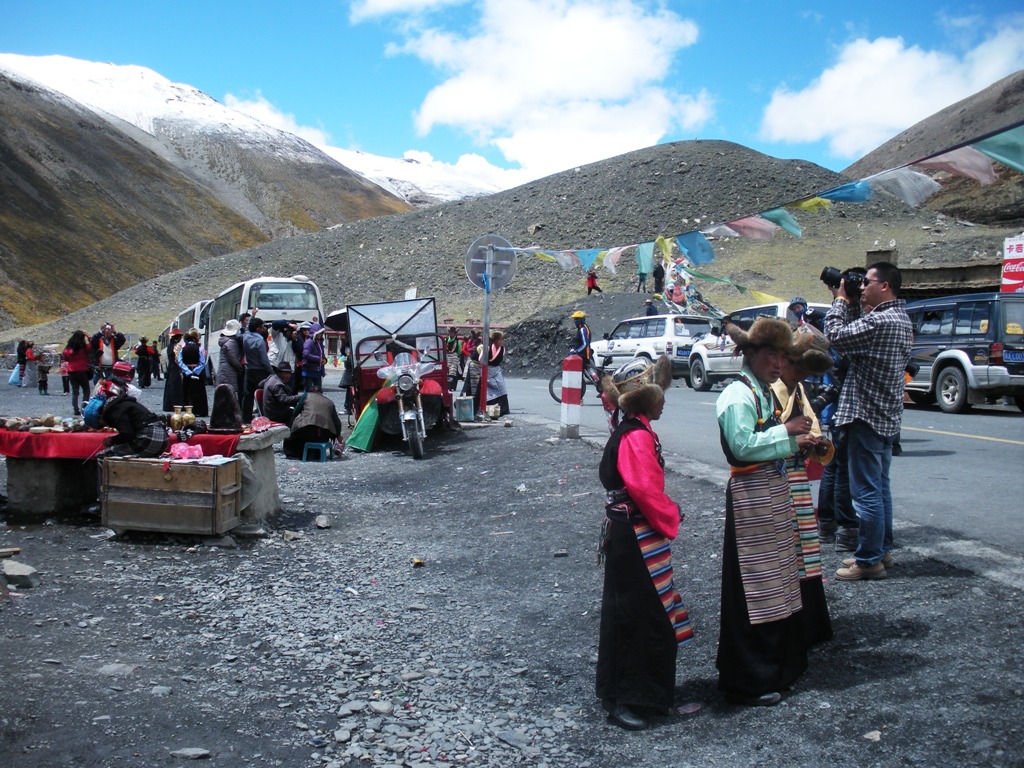
Yep. It's true. Prayer flags are everywhere in Tibet - as if the whole country had a silly string party.


I had thought that people wrote their own prayers on the flags before stringing them up. But it turns out that the flags are pre-printed, & it looks like every string of flags has basically the same thing on it.


Our guide told us that the flags are always printed in five colors: blue for the sky, white for clouds, red for fire, yellow for the earth, & green for water. I always find it interesting how other cultures perceive colors.

White scarves are also ubiquitous. Our guide greeted us on the first day with white scarves. People drape them around statues of Buddha in the temples. & they add them in to the mix of prayer flags on mountain tops.


I didn't ask our guide the significance of the white color, but I know that many Asian countries use white for funerals or to represent death. Here the white scarves seemed to be good-luck talismans, so maybe they are used to evoke good spirits for protection. If you have any insight on this, I'd be interested to hear it.

Sunday, October 9, 2011

Yak poop

On our road trip through Tibet, we passed between beautiful rocky mountains, past fields of barley. A few times we stopped at a farming village to get out & stretch our legs. The houses were simple square structures of one or two storeys, with little adornment except for brightly painted decorations above the windows & doors.


In the middle of the day, when we stopped at these villages, there was no one in sight - as if the towns had been abandoned. But later as we were driving past the barley fields, we saw whole families bent over among the stalks, wielding sharp scythes and stacking the cut grain into neat little teepees.

Several of the houses had disks of yak dung drying on the outer walls. At first, I thought it might be part of the building materials - a resourceful way to keep the stones together. But our guide told us that Tibetans use the dried yak dung cakes as fuel in the winter time.

Thursday, October 6, 2011

If I were to die tomorrow...


Three things to remember:

1. You can't connect the dots looking forward; you can only connect them looking backwards.
2. The only way to be truly satisfied is to do what you believe is great work.
3. Death is the destination we all share.

Tuesday, October 4, 2011

Tibetan Road Trip

My favorite day in Tibet was the day we took a six-hour road trip through the mountains. I love road trips.

Near the beginning of our trip, we stopped at a police checkpoint where our guide got a time-stamped voucher. We had to take a minimum of two hours to drive the 96 kilometers to the next checkpoint. If we arrived early, we would be fined by the minute. The system ensures safe driving without having to employ an abundance of public safety officers. Although at various intervals, we were greeted by very friendly police mannequins.


We started our trip near 12,000 feet - the highest I had ever been before going to Tibet. The two-lane road took a windy path up & up through the mountain tops. We crossed over three or four passes that day, each a little higher than the last.


The final pass brought us to more than 16,000 feet, where we found a rest stop with simple bathrooms, vendors selling jewelry, & Tibetans dressed in traditional clothing looking for someone to take their picture. There we sat in front of a beautiful glacier clinging to the mountain side as our guide took a photo.


Back down the other side of the pass, more beauty as far as the eye could see.

Saturday, October 1, 2011

Debating Monks

One of the most interesting things we saw in Tibet was what they called a "debate" at a Buddhist monastery.

We arrived at the monastery in time to see the afternoon prayer session, the elder monks chanting deep in their throats while a few hundred monks followed along. Well - most of them, anyway. Some of the younger monks on the peripheries were distracted by all the tourists who had come to watch.

After prayer, several monks came into the hall carrying huge cauldrons of cooked rice & beans, & doled out a handful to each of the men. Some monks had wooden bowls & spoons, but most simply used a small plastic grocery bag to eat out of.

The debate was supposed to start at 3:00. While we waited for the monks to gather in the courtyard, our guide told us that they would be debating the doctrines of the religious texts they were studying - an exercise in free thinking.

As they entered the courtyard, the monks paired up, one sitting on a cushion, & the other standing in front of him. According to our guide, the standing monk would pose questions about their studies to his seated partner, & the other would answer.

Of course, we couldn't understand the details of the debate since it was in Tibetan, but the monks were all very animated in their discussions. The standing monk would raise one leg as he asked the question, & stomp it down as he clapped his hands together enthusiastically. The courtyard was alive with the murmer of discussion.

Painted on the wall at one of the temples, we found what our guide called the circle of life. An evil-looking monster grabs at the circle from the outside, while humans go about their daily life on the inside. At the center are three animals: a snake, a chicken and a pig.

The three animals represent the three negative characteristics that humans must transcend if they are to reach nirvana. Our guide couldn't remember the English words for them, but we pieced together his descriptions, & decided on ignorance, jealousy & desire. This debate that we witnessed was the monks' attempt at overcoming their ignorance, bringing them one step closer to enlightenment.